If you’re researching plastic surgery abroad, the first question is usually the same: is plastic surgery safe abroad? The safest answer is never a slogan—it’s a set of verifiable safety standards (yes, some people even search “safety standarts”).
This guide explains how hospital accreditation and government oversight work in Turkey, what JCI accredited hospitals Turkey actually means, and how to spot red flags before you choose a surgeon, a hospital, or what someone calls the best plastic surgery clinic in Turkey.
Key takeaway: Accreditation isn’t a “nice-to-have.” It’s a practical way to reduce risk—because it gives you a checklist you can confirm, not just a promise you’re asked to trust.
Table of Contents
Why Hospital Accreditation Matters for International Patients
When people search for accredited hospitals in Turkey, they’re not chasing a badge—they’re trying to reduce the odds of the two biggest fears: unsafe environments and poor complication handling. Accreditation and oversight matter because they focus on the “system” around your surgery: how a hospital prevents errors, how it responds to emergencies, and how it keeps standards consistent across teams and shifts.
Accreditation, licensing, and authorization sound like bureaucracy. They actually answer a much simpler question: would I trust this place if something went wrong? That question sits at the center of every honest evaluation of plastic surgery in Turkey — and the answer changes dramatically depending on which facility, surgeon, and regulatory framework a patient ends up inside.
For a broader risk evaluation that goes beyond a single accreditation badge, this Turkey cosmetic surgery safety analysis covers regulation, statistics, and the structural variables that actually move outcomes.
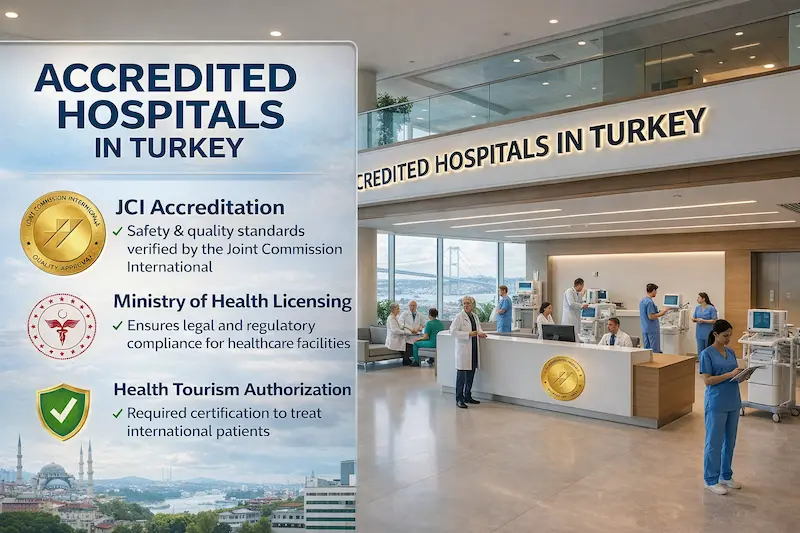
| What you’re checking | What it is (in plain English) | Why it matters for safe plastic surgery |
|---|---|---|
| JCI Accreditation | A voluntary international accreditation focused on patient safety and quality systems. | Signals a mature safety culture (processes, audits, continuous improvement). |
| Ministry of Health (MoH) Licensing | Mandatory government authorization to operate as a healthcare facility in Türkiye. | Confirms the facility is legally permitted and subject to national oversight. |
| Health Tourism Authorization Certificate (Sağlık Turizmi Yetki Belgesi) | Authorization required for organizations providing planned international health tourism services. | Helps ensure foreign-patient services are delivered through the regulated health tourism framework (not informal or “gray-zone” setups). |
What accreditation can (and cannot) guarantee
Accreditation can’t guarantee a perfect aesthetic result. It also doesn’t guarantee a zero-complication experience. What it can do is raise the baseline: standardized protocols, clearer documentation, safer medication processes, stronger infection prevention, and a more reliable escalation pathway if something goes wrong.
That’s why “safe plastic surgery” is rarely about a single factor. It’s the combination of:
- The right facility (licensed and audited)
- The right team (qualified surgeon + anesthesia + nursing support)
- The right plan (pre-op screening, realistic expectations, aftercare)
How accreditation relates to infection control, medication safety, and patient identification
For the expert patient, the value of accreditation is that it pressures the facility to run repeatable safety workflows—especially around:
- Infection prevention (sterilization chain, operating room discipline, wound-care instructions)
- Medication safety (labeling, storage, allergy checks, correct dosing)
- Patient identification (making sure the right procedure is done for the right patient, every time)
These details rarely appear on Instagram. But they are exactly what determines whether a hospital is prepared to deliver consistent outcomes for patients traveling internationally.
Standards on paper are one thing. The equipment, monitoring systems, and protocols that actually run inside the operating room are another. For an international patient, what matters is whether the facility runs the same level of infection-prevention discipline, anesthesia monitoring, and emergency readiness that an accreditation framework would expect.
The clinical equipment, monitoring protocols, and recovery technologies operating behind the scenes are documented in this facility safety infrastructure overview.
Why “where the surgery happens” matters more than marketing claims
Many bad outcomes in medical travel don’t start with “bad intent”—they start with weak systems: unclear responsibility, inconsistent sterilization, limited emergency readiness, or vague aftercare pathways.
For major facial procedures (like a facelift), the facility matters because recovery can hinge on swelling control, wound management, and how quickly concerns are evaluated. At AKM Clinic, facelift care is planned with a surgeon-led approach and (for facial rejuvenation cases) the added expertise of a dermatosurgeon—a meaningful advantage because natural results depend on both skin quality and deeper structural work, not just tightening.
And while no technology replaces good surgery and good nursing, AKM Clinic also uses supportive recovery tools such as HBOT and LLLT as part of post-op care—often requested by patients specifically looking to speed up facelift recovery and make facelift recovery more manageable.
One detail that quietly shapes operating-room safety is anesthesia choice. General anesthesia is the default. It isn’t the only option. Local-anesthesia surgical models reduce airway risk, shorten recovery, and let the surgeon maintain ongoing communication with the patient — but they also depend on rigorous monitoring infrastructure and trained anesthesia leadership to be delivered safely.
For surgeries where general anesthesia carries higher risk or recovery overhead, the awake surgery program covers which procedures are eligible and how monitoring is structured.
What Is JCI Accreditation?
JCI (Joint Commission International) is a globally recognized accreditation body that evaluates healthcare organizations against structured standards designed to improve patient safety and quality of care. In practice, when a hospital is JCI-accredited, it suggests the hospital has implemented—and can demonstrate—repeatable systems, informed by medical science, to reduce preventable harm.
The honest version of the JCI claim isn’t “accreditation guarantees outcomes.” It’s more conditional than that.
A 2025 PLoS One systematic review of JCI accreditation on patient safety screened nearly 300 articles and found that JCI accreditation is associated with measurable improvements in documented patient safety culture and incident reporting — but also noted that the evidence base remains limited and warrants further investigation.
Practically, this means accreditation raises the baseline for what should be in place. It doesn’t replace the patient’s responsibility to verify how those standards are actually being executed in the specific hospital they’re booking.
Who JCI is and what “JCI-accredited” typically covers
JCI accreditation typically focuses on how care is delivered across the hospital—not only what equipment exists. Think of it as evaluating whether patient safety is “built into the process,” including how teams communicate, document care, manage medications, and handle high-risk scenarios.
Common areas audited (patient safety goals, OR standards, infection prevention, governance)
While exact audit details can vary by program and facility, JCI reviews commonly center on themes that matter directly to international patients pursuing plastic surgery:
- Operating room discipline and sterile technique systems
- Infection prevention programs and compliance monitoring
- Medication management (from storage to administration)
- Patient assessment and documentation consistency
- Governance and accountability (who owns quality and safety performance)
How often accreditation is renewed and what “continuous compliance” means in practice
A critical point for skeptical patients: JCI is not meant to be a one-time “trophy.” The expectation is that organizations keep improving and maintain compliance over time. That’s why you should still verify a hospital’s current status directly (and confirm the exact facility name and location match what you’re being told).
Turkey’s Ministry of Health Standards and Oversight
When patients compare accredited hospitals in Turkey, they often focus on JCI first. But there’s another baseline layer that matters for safe plastic surgery: Türkiye’s Ministry of Health (MoH) licensing and regulatory oversight.
Think of it this way:
- MoH licensing answers: “Is this hospital/clinic legally allowed to operate as a healthcare facility in Türkiye?”
- Accreditation (like JCI) answers: “Has this hospital built higher-level safety systems that meet an international framework?”
Licensing basics: what a facility must have to legally operate
For planned surgery, you should confirm that the facility where your operation will happen is a properly licensed healthcare institution (not just an office address or a “medical center” label used in marketing).
At a practical level, licensing typically connects to essentials that affect your risk profile:
- Clinical governance (clear responsibility for patient safety)
- Facility readiness (appropriate operating environment for the procedure being performed)
- Documentation standards (consents, records, discharge summaries)
A licensed healthcare facility on paper and a fully equipped one in practice aren’t the same thing. What an international patient should be able to verify is the physical setup: operating room standards, recovery area, monitoring equipment, and whether the surgery actually happens in a hospital environment with full emergency infrastructure.
The clinic’s operational location, partner hospitals, and infrastructure details are documented in this Istanbul surgical facility profile.
Inspections, reporting, and enforcement (what happens if standards aren’t met)
Ministry oversight exists to enforce national rules. It’s important because “safety standards” are not only about what’s written on paper—regulators can apply consequences when facilities fall short.
As a patient evaluating plastic surgery abroad, what you want is a provider who can confidently answer questions about:
- Where the surgery is performed (exact facility name and address)
- Who provides anesthesia (and what monitoring is used)
- What the emergency plan is (ICU access, transfer pathway, on-call coverage)
What “Ministry-approved” does and doesn’t tell a foreign patient
What it tells you: the facility is operating under the national healthcare framework and is subject to national oversight.
What it doesn’t tell you: whether the hospital is JCI-accredited, whether the specific surgical team is the right fit for your goals, or whether the clinic’s aftercare model is strong enough for international travel timelines (a major factor when people ask, is plastic surgery safe abroad?).
Expert-patient tip: Ask for the exact hospital name and address in writing before you pay a deposit—then verify that this is where your surgery will take place (not “a partner hospital” that changes later).
Health Tourism Authorization Certificate: Why It’s a Non-Negotiable Check
If you’re coming to Turkey for planned care—especially elective procedures like a facelift—there’s an additional, often-overlooked legal and operational filter: the Sağlık Turizmi Yetki Belgesi, often translated as the Health Tourism Authorization Certificate.
This matters because “safe plastic surgery” is not only about technical skill. It’s also about whether foreign-patient services are being delivered through the formal, regulated international health tourism pathway—rather than informal arrangements that can weaken accountability.
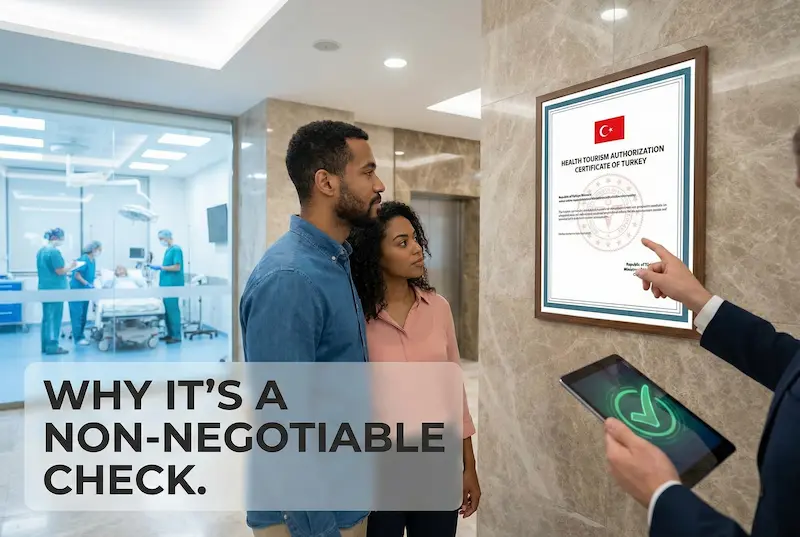
What the certificate is (and who should have it)
In Türkiye, authorization can apply to:
- Health facilities (where treatment is delivered)
- Intermediary organizations (facilitators/agents coordinating international health tourism services)
For patients, the point is simple: if you’re being marketed a package for plastic surgery abroad, you should expect the provider (and any intermediary involved) to be able to clearly show they operate within the health tourism authorization system.
Why it matters legally for planned foreign-patient services
For planned international health tourism services, the authorization certificate is not a “nice extra.” It’s a compliance requirement tied to how international-patient services are structured and monitored.
From a risk-management perspective, this is important because regulated health tourism typically aligns with clearer processes around:
- Patient onboarding and documentation
- Defined responsibilities between clinic/hospital and intermediaries
- Standardized communication and follow-up expectations for international patients
Health tourism vs. tourist emergency care (don’t mix these up)
This is where confusion happens online. A tourist who needs urgent or emergency care is not the same scenario as a patient traveling specifically for an elective procedure.
- Planned health tourism = you travel with the intent to receive medical treatment (e.g., facelift, body contouring).
- Tourist health / urgent care = unplanned medical needs while traveling.
When you’re evaluating jci accredited hospitals turkey options for elective surgery, you’re in the planned category—so it’s reasonable to expect the clinic/hospital to be transparent about their health tourism authorization status.
How to verify it (practical checklist)
Here’s a simple, non-technical way to check legitimacy without becoming a legal expert:
- Ask for the certificate details: the official name of the facility/intermediary, certificate number (if available), and validity/issuance information.
- Match names exactly: the name on the certificate should match the entity you’re paying (or the entity formally responsible for your care).
- Confirm where you’ll be treated: ensure the authorized facility is the same place where your surgery will occur.
- Beware of “borrowed credibility”: a clinic claiming authorization via a different company/hospital name is a red flag unless the relationship is documented and transparent.
If someone says “we’re the best plastic surgery clinic in Turkey,” your next step shouldn’t be belief—it should be verification: facility, accreditation, authorization, and a clear aftercare plan.
JCI vs. Ministry Standards vs. Health Tourism Authorization: Key Differences (And Why All Three Matter)
If your goal is safe plastic surgery, it helps to think in layers. Patients searching JCI accredited hospitals Turkey are often looking for the highest “trust signal,” but the smartest approach is to confirm all three layers:
- Ministry of Health licensing (legal facility operation)
- Health Tourism Authorization Certificate (legal/structured international patient pathway)
- JCI accreditation (advanced, internationally benchmarked safety systems)
| Layer | What it is | What it usually tells you | What it does NOT guarantee |
|---|---|---|---|
| Ministry of Health (MoH) licensing | Mandatory national regulation for healthcare facilities. | The facility is legally permitted to operate and is under national oversight. | That outcomes will be “perfect,” or that the facility meets an international accreditation framework. |
| Health Tourism Authorization Certificate | Authorization for providing planned international health tourism services (facility and/or intermediary). | Your care is being offered via the regulated health tourism framework (better accountability and structure for foreign-patient workflows). | That the provider is JCI-accredited, or that the surgical plan is right for your anatomy and goals. |
| JCI accreditation | Voluntary international accreditation centered on patient safety and quality systems. | Strong system maturity: protocols, audits, safety culture, continuous improvement. | That every doctor is equally skilled for your specific procedure, or that complications can’t happen. |
International benchmarking vs. national regulation vs. legal pathway for foreign-patient services
Here’s the simplest way to interpret it:
- MoH licensing is the legal baseline for the facility.
- Health tourism authorization is the compliance framework for serving planned international patients.
- JCI is a structured, international “quality and safety system” benchmark.
What patient-facing documentation should look like
For any major procedure—especially a facelift—serious providers will be comfortable putting key details in writing. Expect:
- Exact hospital name and address where your surgery will be performed
- Informed consent that explains realistic outcomes and known risks
- Pre-op evaluation plan (labs, medical history, medication guidance)
- Aftercare plan that covers medication, wound care, follow-up schedule, and travel timing
A quick reality check for “best plastic surgery clinic in Turkey” claims
Marketing language is not proof. The strongest signal of quality isn’t a slogan—it’s a provider who welcomes verification, explains limitations, and can show how their systems support safety and recovery.
Patient-safety mindset: If a clinic can’t clearly explain where your surgery happens, who is responsible for anesthesia, and how complications are handled, “accredited” becomes a word—not a safeguard.
How to Verify JCI, Ministry Claims, and the Health Tourism Authorization Certificate
If you’re researching accredited hospitals in Turkey for plastic surgery abroad, your goal is to validate claims with minimal effort and maximal clarity. Use the steps below as a practical checklist (and don’t hesitate to request documents before you pay a deposit).
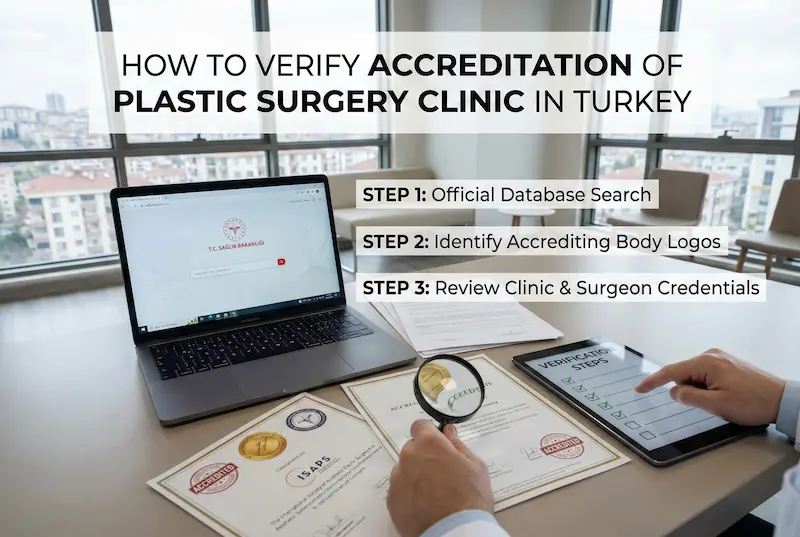
Step-by-step: Verify “JCI accredited hospitals Turkey” claims
- Ask for the exact hospital name (spelling matters—many hospitals have similar names).
- Check the hospital in the official JCI directory and confirm it matches the same legal entity and location.
- Confirm it’s the same facility where your surgery will happen (not “JCI in the city,” not “our partner is JCI,” but the actual operating hospital).
- Request confirmation in writing on your plan: hospital name, address, and the procedure date/location.
Verifying a facility certificate is one workflow. Verifying the surgeon who will actually operate is a separate one — and patients often skip it. The reason matters: a JCI-accredited hospital doesn’t guarantee that every physician operating inside it has the specialty training, licensing, or scope of practice for what’s on your treatment plan.
For the surgeon-specific side of verification, the parallel workflow is laid out in this surgeon licensing verification process.
Step-by-step: Verify the facility and “where the surgery happens”
- Request a written care pathway: pre-op tests, surgery day plan, post-op monitoring, discharge criteria, and follow-ups.
- Ask who provides anesthesia and what monitoring is used during surgery.
- Ask about emergency readiness: ICU access, on-call physician coverage, and transfer pathways if needed.
- Get clarity on aftercare ownership: who answers urgent questions after hours, and how issues are managed once you fly home.
Facility accreditation and surgeon certification work as a pair. One audits the building; the other audits the individual holding the scalpel. Neither alone is enough. A board-certified surgeon operating in an unaccredited facility carries different risks than an uncertified physician working in a JCI-accredited hospital — and patients should evaluate both layers.
The parallel logic for evaluating the surgeon side — what a real board credential proves and how to verify it — is covered in this board certification verification guide.
Step-by-step: Verify the Health Tourism Authorization Certificate (Sağlık Turizmi Yetki Belgesi)
This step is especially relevant to the question, is plastic surgery safe abroad?—because it confirms you’re dealing with a provider operating through the regulated international health tourism framework.
- Ask for the certificate details (entity name, documentation, validity info).
- Match the name to who you are paying (or to the formally responsible entity for your care).
- Clarify intermediary involvement: if an agency/facilitator is coordinating, ask how responsibilities are split and documented.
- Ensure transparency: a professional provider will not avoid this conversation.
Red Flags That Undermine Safety Standards (Even If the Website Looks Professional)
Some of the biggest risks in plastic surgery abroad don’t show up in ads. They show up as “small” inconsistencies that signal weak systems. If you’ve ever typed “safety standarts” into Google, this is the real-world version of that search.
Red flag #1: Vague or changeable hospital details
- They won’t provide the exact hospital name and address upfront.
- They say “partner hospital” but can’t confirm which one in writing.
- Your invoice or payment request doesn’t clearly match the responsible entity.
The case for accredited, well-regulated facilities isn’t just theoretical. It has been measured in downstream complication data. A 2024 Surgeon journal retrospective analysis from a UK level-one trauma center documented 81 patients presenting to a single NHS unit over five years with complications from cosmetic surgery performed abroad — with year-on-year increases peaking at 29 patients in 2023.
The finding worth flagging: complications cluster around informal, unregulated setups — not around accredited facilities operating under documented safety frameworks. Choosing where surgery happens is one of the most controllable risk factors on the table.
Red flag #2: Overpromising language (“zero risk,” “guaranteed results”)
In real medicine, complications are discussed and planned for—even when they’re unlikely. Absolute guarantees often signal a sales-first approach rather than a safety-first system.
Red flag #3: Weak aftercare planning (a major driver of poor recovery experiences)
Patients often focus on the surgery day—but outcomes depend heavily on the plan for facelift recovery, including swelling management, wound care, and follow-up access once you’re traveling.
- No written follow-up schedule
- No clear contact pathway for urgent questions
- Unrealistic travel timing advice
Supportive tools (like HBOT and LLLT) can be useful adjuncts in a surgeon-led recovery protocol, and some patients seek them specifically to speed up facelift recovery. But they should never be presented as a substitute for fundamentals: safe facility, qualified surgical team, and structured aftercare.
A polished website doesn’t tell you much. A documented operational profile does. What separates a defensible clinic from a marketing-only setup is how it answers concrete questions — about ownership, governance, who is medically responsible, and what the escalation pathway looks like at 2 AM.
The criteria patients should actually weigh when comparing options are laid out in this clinic selection evaluation framework.
Safety Checklist: Questions to Ask Before You Pay a Deposit
If you’re considering plastic surgery abroad, your deposit should come after basic verification—not before. This is where “safe plastic surgery” becomes practical: you ask specific questions that reveal whether a provider has real safety standards (or just marketing language). If you’ve ever searched “safety standarts,” use the checklist below as your real-world version of that search.
Hospital details: ICU access, emergency response, blood bank/transfer pathway
- Where exactly will the surgery take place? (Full hospital name + address, in writing.)
- Is there ICU capability on-site (or an immediate escalation pathway) if needed?
- What’s the emergency plan? Who is responsible after hours, and how are urgent issues handled?
- If a transfer is needed, what is the pathway? (Which facility, how, and who coordinates.)
A facility’s accreditation doesn’t transfer to the people operating inside it. Each surgeon, anesthesiologist, and nurse on your case carries their own credentialing — and their own accountability. Patients should be able to see, by name, who is leading anesthesia, who is performing the surgery, and who is responsible for follow-up coordination.
The full clinical lineup — primary surgeons, surgical team, and supporting medical staff — is listed in the AKM medical team directory.
Non-negotiable: “We use a partner hospital” is not an answer. You need the exact hospital identified before you commit—especially if you’re choosing based on JCI accredited hospitals Turkey claims.
Anesthesia safety: who provides it, monitoring standards, pre-op clearance workflow
- Who provides anesthesia? Ask for the anesthesia provider’s role and qualifications (and whether a dedicated anesthesia professional is present throughout).
- What monitoring is used during surgery? (You’re looking for a serious, standard-of-care answer—not “don’t worry.”)
- What is the pre-op medical clearance process? What labs, screening, and medication guidance will you receive?
- What happens if my pre-op results are not suitable? (A safety-first clinic will be willing to postpone or decline if needed.)
Infection prevention: sterilization, antibiotic protocols, post-op wound care plan
- How is sterilization handled? Ask about instrument processing workflow and OR discipline (a credible provider explains the system, not just “we’re clean”).
- What is your infection prevention approach? (Pre-op instructions, day-of protocols, and post-op monitoring.)
- What is my wound-care plan? Get written instructions, not verbal-only guidance.
- Who evaluates concerns during recovery? (In person before you travel home, and remotely after.)
| Question you ask | What a strong answer looks like | What a weak answer looks like |
|---|---|---|
| “Which hospital will perform my surgery?” | Exact facility name + address, confirmed in writing. | “Our partner hospital,” “it depends,” or name changes later. |
| “How do you handle complications?” | Clear pathway (assessment, escalation, documentation, responsibility). | “We never have complications,” or avoidance. |
| “What’s my post-op plan?” | Written schedule, contact pathway, travel timing guidance. | No written plan, vague reassurances only. |
Deposit-Safe Verification Workflow for JCI Accredited Hospitals Turkey
Choosing a provider abroad should never rely on promises alone. The safest way to reduce risk is to use a “deposit-safe” workflow that verifies the facility, the legal framework for treating international patients, and the clinic’s readiness to manage both routine recovery and unexpected issues. This step-by-step approach is designed for patients comparing options in Türkiye—especially those prioritizing JCI Accredited Hospitals Turkey as a trust signal—while also recognizing that Ministry oversight and health tourism authorization play critical roles in real-world safety standards.
Step 1: Confirm the exact operating hospital in writing
Before paying anything, request the full hospital name and address where your surgery will occur, plus the planned date. Names must match exactly across your surgical plan, invoices, and any certificates shown. If you hear “partner hospital” without a fixed name, treat it as a red flag. Transparency here protects you from last-minute facility changes and makes all further verification possible.
Step 2: Verify accreditation and legal readiness for international patients
If the hospital is presented as JCI-accredited, cross-check the exact facility name in the official directory and ensure it’s the same location where you’ll be treated. Next, ask for clarity on the Health Tourism Authorization Certificate (Sağlık Turizmi Yetki Belgesi) for planned foreign-patient services—especially if an intermediary is involved. This helps confirm your care is delivered through the regulated international health tourism pathway, not an informal setup with weaker accountability.
Verifying accreditation in advance is one step. Knowing what your week in Istanbul will actually look like is another. For patients flying in for surgery, the difference between a smooth experience and an anxious one usually comes down to logistics that were resolved before the trip — transfers, hospital admission, surgery day, hotel coordination, fit-to-fly checks.
The full pre-arrival to post-flight structure is mapped out in this international patient pathway map.
Step 3: Demand minimum documentation and a clear recovery ownership plan
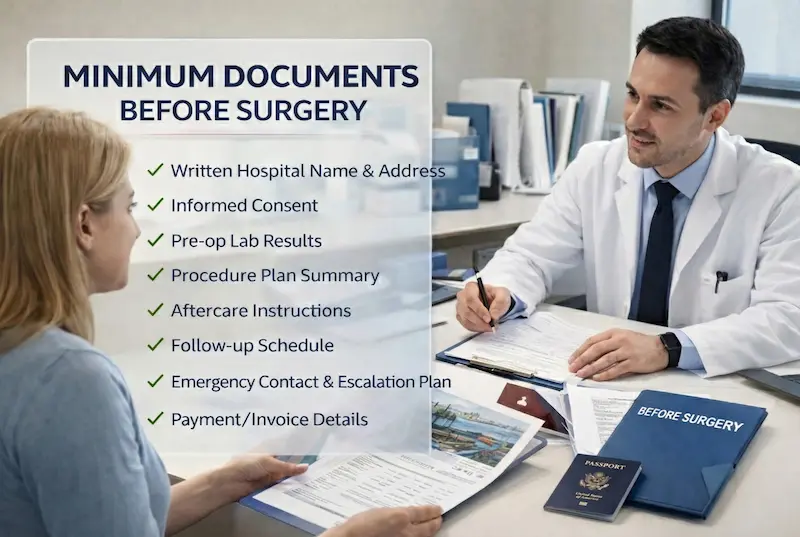
- Informed consent with realistic outcomes, risks, and complication pathway
- Pre-op testing plan and medication/supplement instructions
- Written aftercare, follow-up schedule, and emergency escalation contacts
- Anesthesia details, monitoring standards, and emergency readiness (ICU/transfer pathway)
When these elements are clear, your decision becomes evidence-based—and your recovery timeline is more predictable, supported, and patient-centered.
Minimum Documents You Should Receive (Before Surgery)
Whether you’re choosing among accredited hospitals in Turkey or evaluating the “best plastic surgery clinic in Turkey” claims, documentation is part of safety. These items protect you because they clarify responsibilities and reduce misunderstandings—especially when you’re traveling internationally.
Facility proof: where you’re treated + why that matters
- Written confirmation of the operating facility (hospital name + address)
- If you’re choosing based on “jci accredited hospitals turkey”: a screenshot/link reference is not enough—names must match exactly
- Health Tourism Authorization Certificate details (Sağlık Turizmi Yetki Belgesi) for planned foreign-patient service delivery
Clinical documentation: consent, risks, and realistic outcomes
- Informed consent that covers known risks, limitations, and what happens if concerns arise
- Pre-op assessment and instructions (medications, smoking/alcohol guidance, supplements, lab work)
- Procedure plan summary (what is being done—and what is not)
Aftercare documentation: recovery ownership and timeline clarity
Many negative experiences in plastic surgery abroad aren’t caused by the surgery itself—they’re caused by unclear aftercare ownership once the patient flies home. For facial surgery, this directly impacts facelift recovery.
- Written aftercare instructions (wound care, medication, sleeping position, activity restrictions)
- Follow-up schedule (in-clinic checkups before departure + remote follow-ups)
- Escalation plan (what symptoms trigger urgent review, and how to reach the team)
Recovery note: Some clinics offer supportive recovery tools (for example, HBOT and LLLT) that patients may seek to speed up facelift recovery. These can be helpful adjuncts, but the foundation is always: qualified team, safe facility, and a written recovery plan.
Beyond Paperwork: Other Trust Signals an Expert Patient Should Check
Paperwork matters—but it’s not the whole story. If your real question is is plastic surgery safe abroad? the most reliable signal is how a clinic behaves when you ask serious questions: transparency, realism, and a clear plan for prevention and response.
Certificates and ministry documents prove process. Patient reviews tell you what happened when the process was actually applied. The useful ones aren’t five-star quick takes. They describe the day-of experience, the follow-up cadence, how complications were handled, and what didn’t go to plan.
That kind of long-form patient evidence is collected in the clinic’s documented patient testimonial archive.
Surgeon credentials and scope-of-practice (validate properly)
- Ask who will actually perform each part of the surgery (not only who “consults”).
- Ask about procedure volume for your specific operation.
- Ask how the team approaches natural results (for facial work, skin quality + structure both matter).
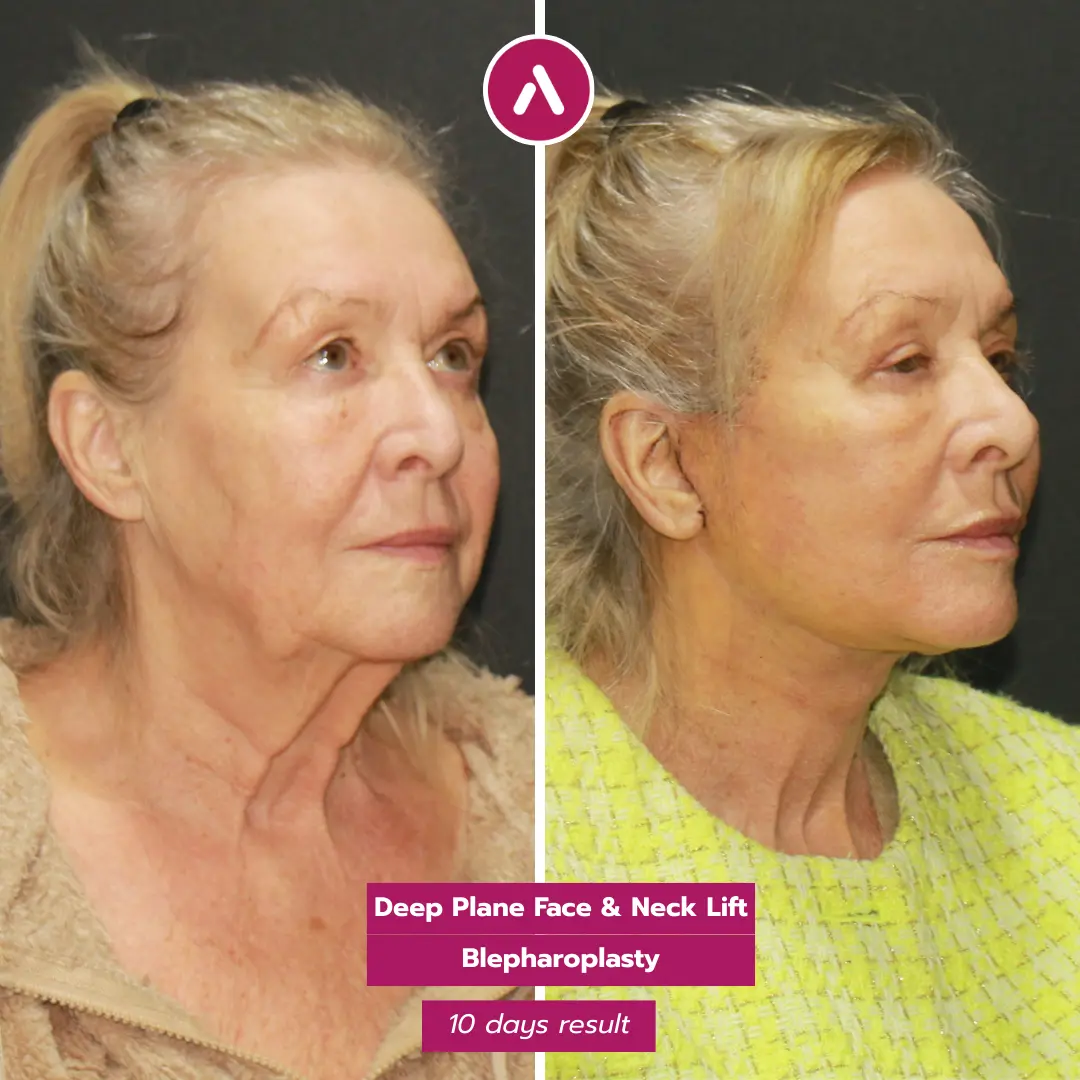
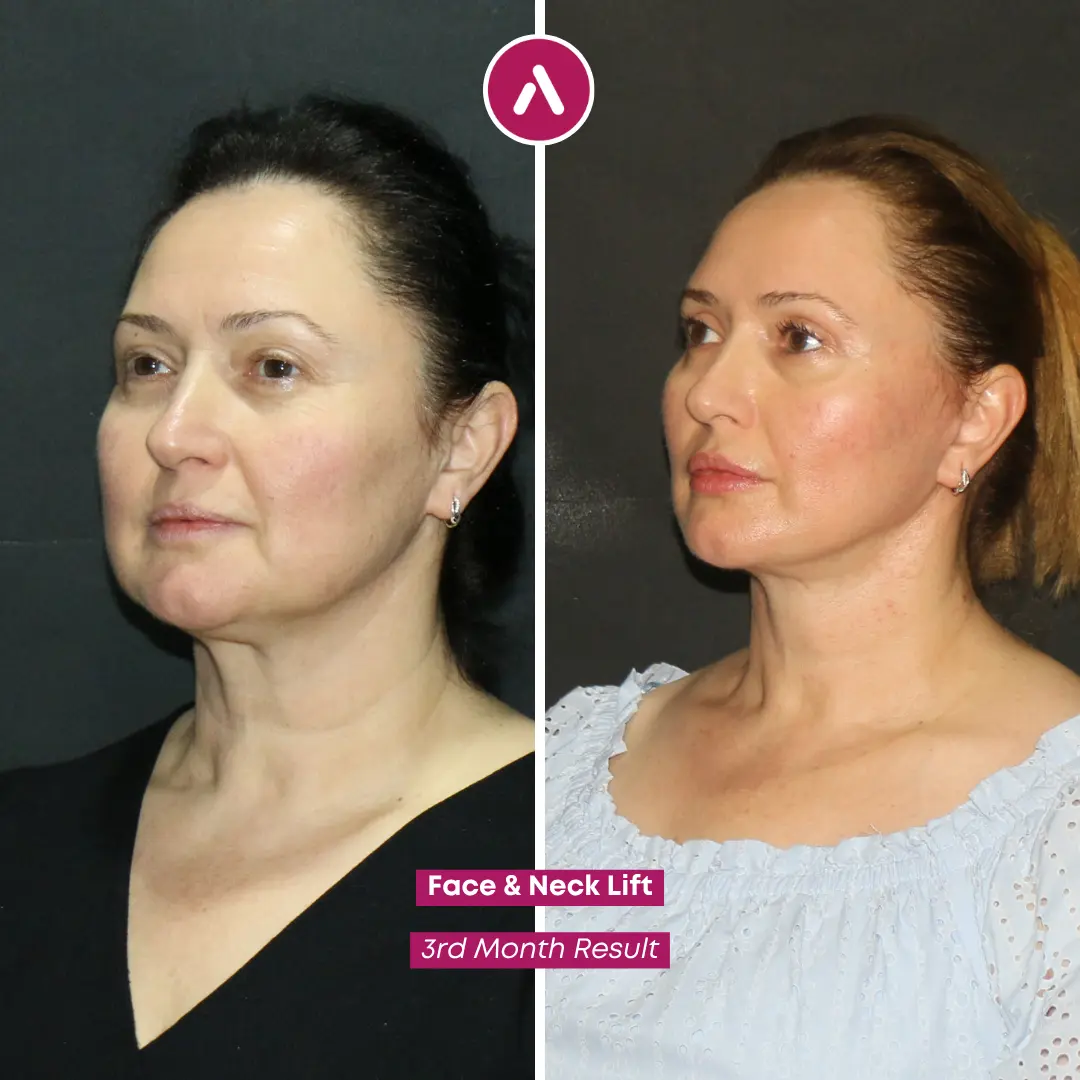
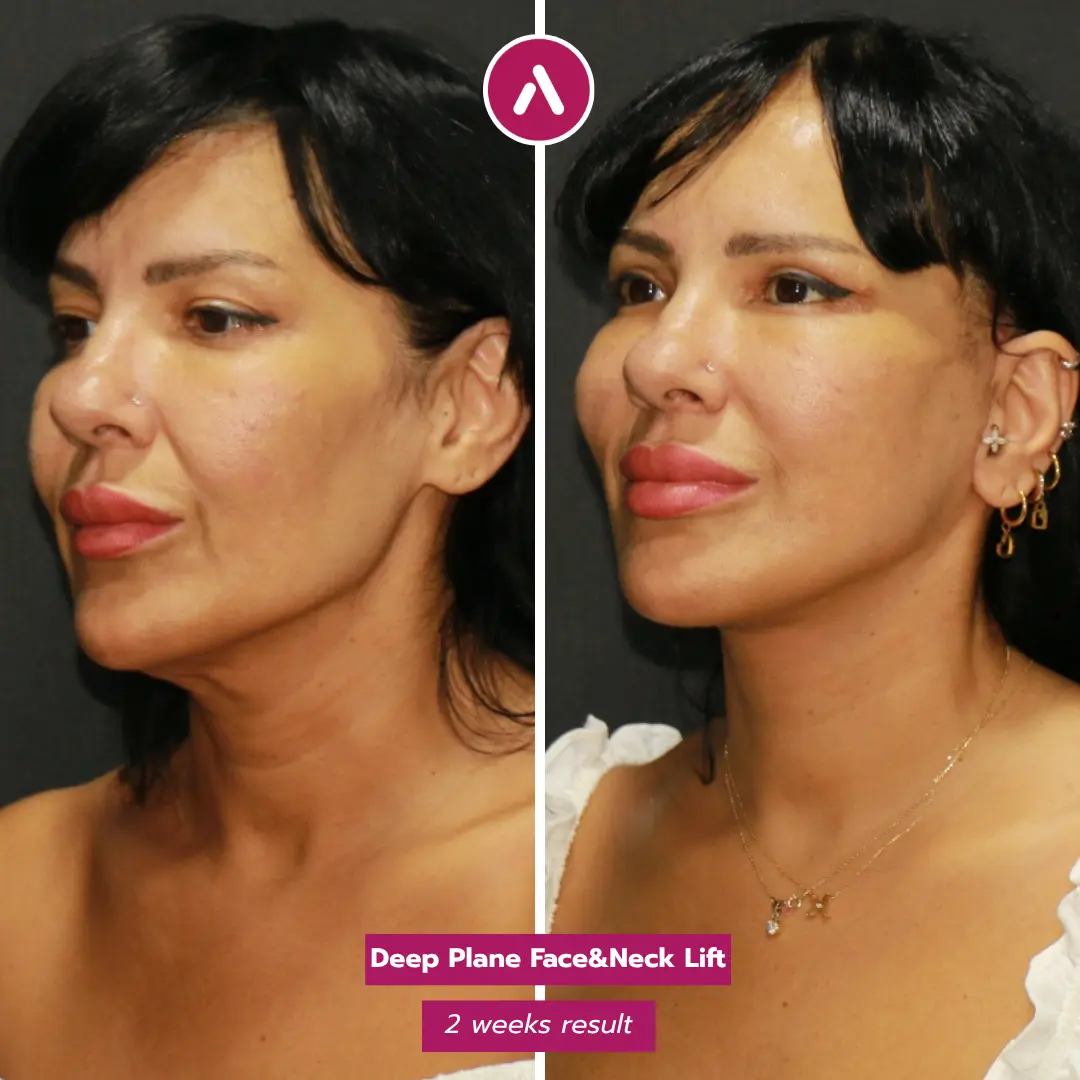
For facial rejuvenation procedures like facelifts, AKM Clinic emphasizes a surgeon-led model and includes dermatosurgeon expertise alongside the plastic surgery team—because achieving natural outcomes often requires attention to both skin quality and deeper anatomical structure, not just tightening.
Transparency standards: realistic results, limitations, complication plan
- Do they discuss limitations? (A strong clinic tells you what’s realistic for your anatomy.)
- Do they explain risks without minimizing? (Safety-first, not sales-first.)
- Do they have a clear complication pathway? (Not “it won’t happen,” but “here’s what we do if it does.”)
Post-op care quality: follow-up schedule and recovery-support infrastructure
- Do you have structured follow-up? Especially important for facelift recovery.
- Is communication defined? Who answers after-hours concerns?
- Is travel timing discussed responsibly? Unrealistic timelines are a major safety risk.
JCI Accredited Hospitals Turkey Frequently Asked Questions (FAQ):
These are the most common “expert patient” questions we hear from people comparing accredited hospitals in Turkey and trying to decide whether plastic surgery abroad is truly safe. Use them as a checklist—because real safety standarts are something you verify, not something you assume.
Are all top hospitals in Turkey JCI-accredited?
No. Some excellent hospitals are not JCI-accredited, and some JCI-accredited hospitals may not be the best fit for your specific procedure. JCI is a strong trust signal, but it’s not the only indicator of a safe, well-run facility.
Is JCI “better” than Ministry of Health oversight?
They are different layers. Ministry of Health oversight is the legal baseline for operating as a healthcare facility. JCI is an additional international framework focused on mature patient-safety systems. For safe plastic surgery, it’s ideal when a provider can demonstrate strength in both.
What is the Health Tourism Authorization Certificate, and who should have it?
It’s an authorization tied to providing planned international health tourism services. If you’re traveling for an elective procedure (like a facelift), it’s reasonable to expect transparency about this authorization from the facility and/or any intermediary coordinating your care.
Is it legal to offer planned foreign-patient services without the authorization certificate?
For planned international health tourism, operating within the authorized framework is a core compliance expectation in Türkiye. If a provider avoids the topic, can’t share details, or routes everything through unclear entities, treat that as a serious red flag and re-evaluate.
Can a hospital be safe without JCI?
Yes—especially if it’s a properly licensed hospital with strong internal protocols, an experienced surgical team, and a clear complication pathway. Still, many patients deliberately prioritize JCI accredited hospitals Turkey options because it can be easier to validate safety systems at a glance.
How do I confirm where my surgery will actually be performed?
Ask for the exact hospital name and address in writing, before you pay a deposit. Then verify that the same facility is where you will be operated on—especially if your decision is based on jci accredited hospitals turkey claims. Avoid “partner hospital” answers that can change later.
What should I do if my priority is a smooth facelift recovery (and speeding it up safely)?
Start with fundamentals: a safe facility, surgeon-led planning, written aftercare, and realistic travel timing. To speed up facelift recovery safely, supportive add-ons (like structured lymphatic care protocols or clinician-supervised adjunct technologies) may help—but they only work well when the core recovery plan is strong. The best facelift recovery outcomes typically come from clear instructions, consistent follow-up, and a clinic that owns your aftercare even after you fly home.
Does JCI accreditation apply to the clinic, the hospital, or both?
JCI accreditation is typically granted to a specific hospital organization (and sometimes a defined facility network), not automatically to every clinic that works with it. If a clinic markets JCI Accredited Hospitals Turkey, confirm the exact hospital name and address where your surgery will occur and verify that specific facility’s JCI status.
What if my surgeon consults in one location but operates in another?
This is common in medical travel. What matters is the operating facility. Ask for written confirmation of the surgery hospital’s name/address and ensure your consent forms and invoices reflect the same entity. This protects you from last-minute changes and supports safer plastic surgery abroad planning.
How do I know the “Health Tourism Authorization Certificate of Turkey” is relevant to my case?
If you’re traveling for a planned elective procedure, the Health Tourism Authorization Certificate Of Turkey is a meaningful compliance check because it relates to regulated international health tourism services. Ask who holds the authorization (facility and/or intermediary) and ensure the responsible party matches who you’re paying.
What travel timing helps protect facelift recovery after surgery abroad?
For smoother facelift recovery, avoid rushing flights. Request a written follow-up schedule, discharge criteria, and an escalation plan before departure. If you’re trying to speed up facelift recovery, focus first on fundamentals—safe facility, clear aftercare, and realistic travel timing—then consider supportive, clinician-supervised adjuncts.
Medical Disclaimer: This content is for educational purposes only and does not replace medical advice, diagnosis, or treatment. Surgical options, anesthesia choices, risks, costs, and recovery vary by individual. Always consult a qualified, board-certified clinician for personalized guidance. If you have urgent symptoms, seek emergency care.